Paramita Barai -- Research Work
PhD Research
Modeling the Power Evolution of Classical Double Radio Galaxies
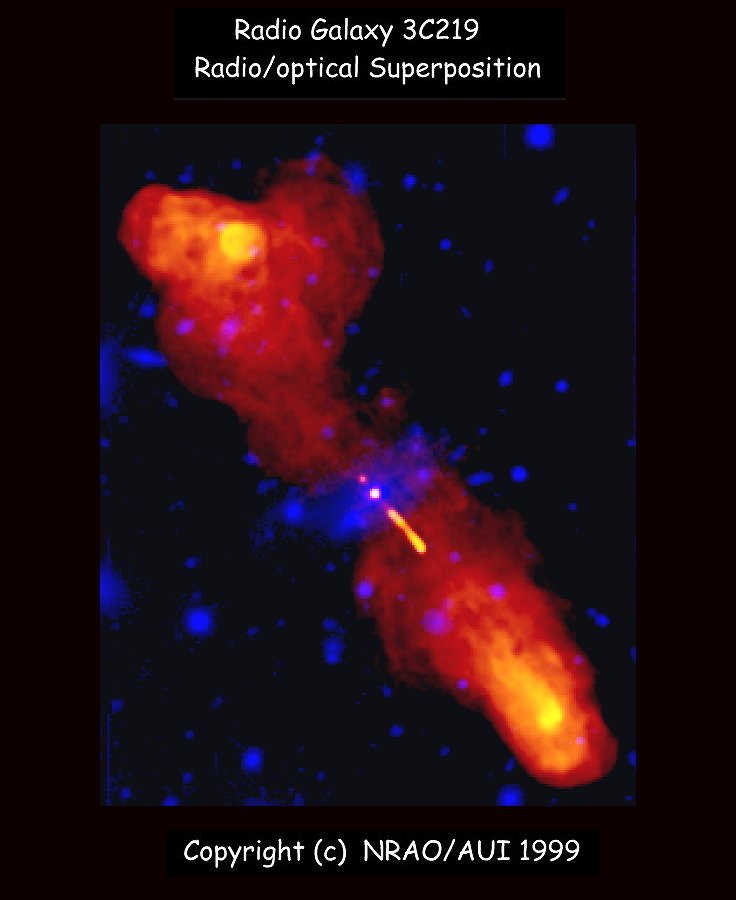
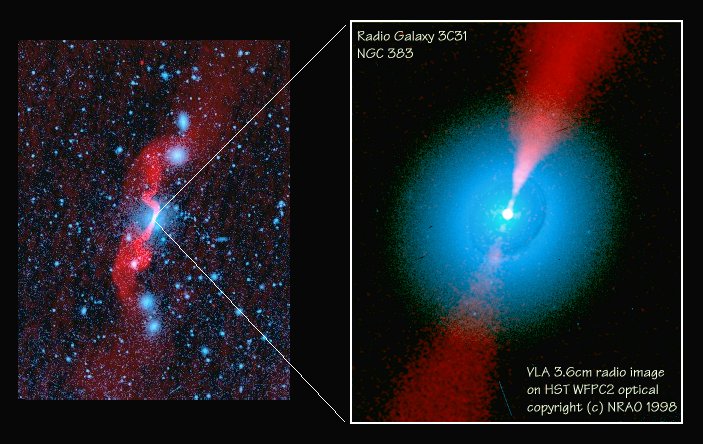
My PhD thesis is on the Evolution of Radio Galaxies over
Cosmological Timescales.
The ultimate goal is to develop a simple, analytical model
for the power evolution of Radio Galaxies as they get older.
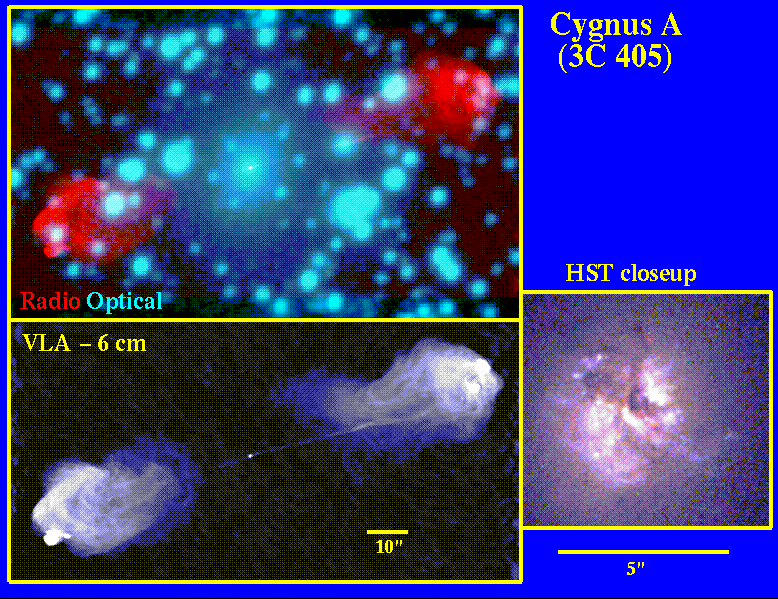
I concentrate on FR-II (Fanaroff-Riley Class II) galaxies with two huge
radio lobes on opposite sides (& hence the name classical doubles).
The expanding lobes of the Radio Galaxies have been found to have
non-trivial impact on the cosmological history of the universe.
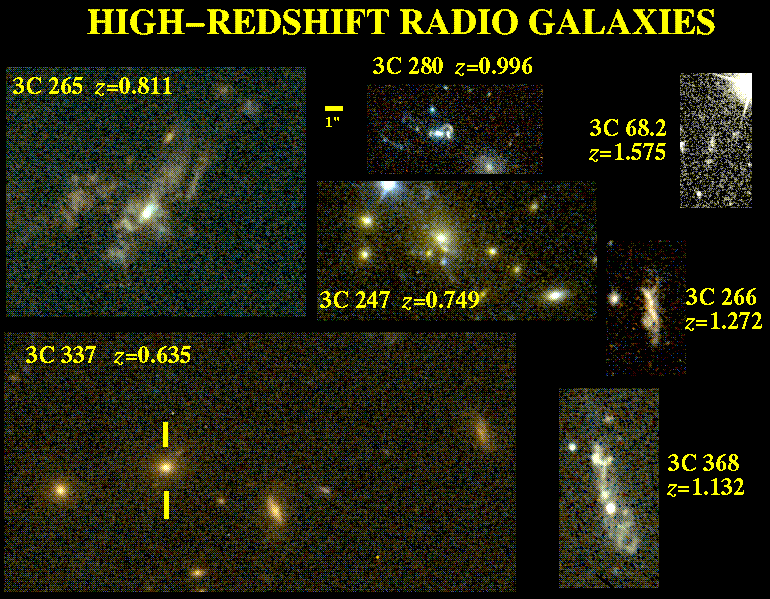
The most substantial effect of these radio lobes is on galaxy formation and evolution during
the quasar era (i.e. between redshifts of 1.5 and 3).
During the quasar era, only a small fraction
(roughly 10% of the mass and 3% of the volume)
of the existing baryons
had yet settled into a proto-galactic cosmic web.
We term this filamentary volume of the universe
(containing the gas that formed all the galaxies eventually)
as the Relevant Universe.
It has been found that during the quasar era, the star and galaxy formation
rates of the universe were considerably higher than at the present epoch.
Also the comoving density of radio sources in the quasar era
was upto 1000 times higher than now.
These observations give rise to the natural question: is there a
causal connection between the two mentioned events?
I am working with my mentor
Paul J. Wiita and in collaboration with
Gopal-Krishna;
trying to probe this important issue of Radio Galaxy impact on
some of the events related to the cosmological evolution of the universe.
Our main quest is to search for a reasonable answer to the question:
What fraction of the volume of the Relevant Universe do the radio lobes occupy?
Some other key questions we are interested in:
- Can these expanding lobes of radio galaxies trigger
large scale star formation in other galaxies?
- What is the impact of radio lobes on metal enrichment
of the intergalactic medium on a large scale?
- Do the lobes play a large role in spreading magnetic field?
 As an initial step toward getting the answers of all these questions,
I am seeking an analytical model for the cosmological evolution of radio galaxies.
Presently I am comparing some well known and sophisticated models
for power evolution of FR-II radio galaxies
aiming to figure out the best model parameters.
I test the models statistically by comparing the model predictions
with some complete observational samples of radio source surveys and
try to find the sigficance level of each model.
As an initial step toward getting the answers of all these questions,
I am seeking an analytical model for the cosmological evolution of radio galaxies.
Presently I am comparing some well known and sophisticated models
for power evolution of FR-II radio galaxies
aiming to figure out the best model parameters.
I test the models statistically by comparing the model predictions
with some complete observational samples of radio source surveys and
try to find the sigficance level of each model.